Learn how to play Magic: The Gathering — mana colors, card types, combat, and turn structure explained visually for beginners.
Magic is a strategy card game where two or more players battle using custom-built decks of cards. Each player starts at 20 life (40 in Commander format). You cast spells, summon creatures, and use tactics to reduce your opponent's life to zero. With over 27,000 unique cards across 30+ years, no two games are ever the same.
Win by reducing your opponent from 20 → 0 life (or 40 → 0 in Commander).
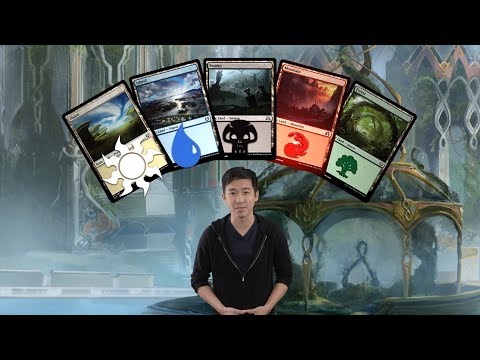
Mana is the magical energy that powers every spell. Each color comes from its own type of land, with unique strengths and play style. Tap (turn sideways) a land to produce one mana of its color.
Order, protection, healing. Small creatures and enchantments that grow stronger together.
Intellect, control, illusion. Draws extra cards and counters opponents' spells.
Power, ambition, death. Destroys creatures, drains life, and raises the dead.
Freedom, chaos, fire. Fast damage with burn spells and aggressive creatures.
Nature, growth, strength. Ramps mana and plays the biggest creatures.
Images via Scryfall
Every Magic card has a type that determines when you can play it and how it works. Lands produce mana. Creatures attack and block. Spells have powerful one-time or ongoing effects.
Produce mana — the resource to cast everything else. One land per turn from your hand.
Your attackers and defenders. Each has power (damage) and toughness (health).
Cast anytime — even on your opponent's turn. Resolve once and go to the graveyard.
Powerful one-time effects — only castable during your main phase.
Persist on the battlefield and modify the game's rules. Some attach to creatures.
Colorless permanents — equipment, mana rocks, and utility. Any deck can use them.
Images via Scryfall
Every Magic card follows the same layout. Here's how to read one:
To cast a spell, pay its mana cost by tapping your lands. The cost is shown in the top-right corner of the card.
Combat is how you win the game. During your combat phase, you choose which untapped creatures attack. Your opponent then decides which creatures to block with. Creatures can't attack the turn they enter the battlefield (summoning sickness) unless they have haste.
Your opponent attacks you with a 4/3 creature and a 2/1 creature. You have one untapped 2/2 creature available to block. What do you do?
Each turn has 5 phases in a fixed order. Combat has 5 sub-steps. Understanding this flow prevents most rules disputes.
Images via Scryfall
Your deck, face-down. Draw one card per draw step. If you must draw and cannot, you lose the game (Rule 104.3c).
Cards you've drawn — private to opponents. Maximum hand size is 7; discard excess during cleanup step.
Where permanents exist: lands, creatures, artifacts, enchantments, planeswalkers. All players share this zone.
Destroyed, discarded, or sacrificed cards go here. Face-up and visible to all players. Order can matter.
Removed from the game. Cards here usually cannot return unless an effect specifically says so.
In Commander, your commander starts here. Emblems and other special objects also exist in this zone.
Where spells and abilities wait to resolve. Last in, first out — the most recently added item resolves first.
Many creatures have keyword abilities — single words that represent game rules. Here are the most important ones you'll encounter.
The game automatically checks these conditions whenever a player would receive priority. No player can respond — they just happen.
A player with 0 or less life loses the game immediately.
A creature with damage equal to or greater than its toughness is destroyed.
A creature with 0 or less toughness is put into its owner's graveyard.
If a player controls two or more legendary permanents with the same name, they choose one to keep and put the rest into the graveyard.
A player with 10 or more poison counters loses the game.
A player who must draw from an empty library loses the game.
A token that has left the battlefield ceases to exist as a state-based action.
Triggered abilities start with the words 'When,' 'Whenever,' or 'At.' They trigger automatically when their condition is met and go on the stack. The controller of the triggered ability doesn't choose to trigger it — it happens automatically.
Commander is the most popular multiplayer format with unique rules beyond standard Magic.
Your deck contains exactly 100 cards including your commander. No duplicates — except basic lands.
Your commander starts in the command zone, not your deck. You cast it from there at any time you could cast a creature.
Every card in your deck must match your commander's color identity. A blue/black commander cannot use red cards — even if they have alternate mana costs.
All players start at 40 life (not 20). Plan your strategy across more turns. Card value is higher in long games.
If a single commander deals 21 or more combat damage to you across the game, you lose immediately — regardless of life total.
Each time you recast your commander from the command zone (after it dies or is exiled), it costs 2 additional generic mana. This accumulates every recast.
Standard Commander is 4 players. Threat assessment, timing, and table politics matter as much as raw card power.
If you control two legendary permanents with the same name, you must immediately choose one and put the rest into your graveyard. This is a state-based action — no player can respond.
One Commander precon deck is all you need to start. Here's everything you'll eventually want.

The fastest way to start. 100 ready-to-play cards with built-in synergy. No deckbuilding required.
Match your playstyle: Aura/creature (white), control (blue), reanimation (black), aggro (red/green).

Protect cards during shuffling. Required for any deck you care about.
Standard size (63.5×88mm). Dragon Shield Matte or KMC Hyper Mat are popular.

Protects cards from table surfaces and defines your play area.
Standard size (60×35cm). Any art you like.

Carry and protect your 100-card Commander deck safely.
Double-sleeved capacity (~110 cards) for Commander decks.

Track 40-life starts, +1/+1 counters, and the 21-commander-damage threshold.
A D20 for life tracking + small d6s for counters. Or use a life-tracking app.
Weekly price movers — real eBay sold data, updated every week.
View Weekly Stack ReportRecent sets worth tracking for singles and sealed product.
Evergreen reprint set — Aether Vial, Vampiric Tutor, and key staples reprinted.
Horror-themed set with strong enchantment and transform synergies.
Powerful non-rotating set. Major Commander, Modern, and Legacy staples.
Western plane with crime mechanics and solid Commander value picks.
Crossover set. The One Ring (serialized) sold for record price. Many Commander staples.
Cards consistently in demand across Commander tables.
Images via Scryfall